
How to Tell Intuition From Fear When You’re Tired
Is this my intuition or fear?
You know the moment.
You’re standing in the kitchen, or sitting in your car, or lying awake at 2 a.m., and there’s a voice somewhere in your chest. Or your gut. Or somewhere you can’t quite name. And the same question keeps circling — is this my intuition, or am I just scared?
Most articles on how to tell intuition from fear hand you a checklist. Intuition feels calm. Fear feels frantic. Intuition is in the body. Fear is in the head. You read it. You nod. You close the tab. And you’re still standing there with the same decision and no clearer answer.
Here’s what those checklists miss. When you’re tired, the channel between you and your own knowing gets fuzzy. Not gone. Fuzzy. And the harder you push to figure it out, the further from the answer you get.
This isn’t a failure of your intuition. It’s a failure of the framing.
You can’t think your way to a knowing
Intuition doesn’t live in the same room as analysis.
That’s the actual issue. You’re standing in the room of thought — comparing options, weighing pros and cons, running every possibility — and asking your intuition to come meet you there. It can’t. It speaks a different language. It arrives in a different way.
Most people who can’t tell intuition from fear aren’t broken. They’re trying to use the wrong tool. They’re sitting at a desk with a spreadsheet, asking a body-based knowing to show up in a column. It won’t.
The first move isn’t to sharpen your thinking. It’s to put it down for long enough to feel anything else.

Fear repeats. Intuition arrives once.
This is the distinction almost no one teaches, and it’s the one that actually works.
Fear has a loop. It says the same thing over and over in slightly different costumes. What if it doesn’t work? What if you’re wrong? What if you regret it? What if they leave? What if you fail? It’s a soundtrack. Once you notice it, you’ll see it’s the same six lines on rotation.
Intuition doesn’t repeat. It arrives once, clean, and then it’s quiet. It doesn’t argue with you. It doesn’t make a case. It says the thing — don’t go, go, leave, stay, ask, don’t ask — and then it lets go. The signal is over. Whatever comes after, if it doesn’t stop, is fear dressed up as confirmation.
If you’re hearing the same message twenty times today, that’s not your intuition getting louder. That’s fear keeping you company while you avoid making a decision.
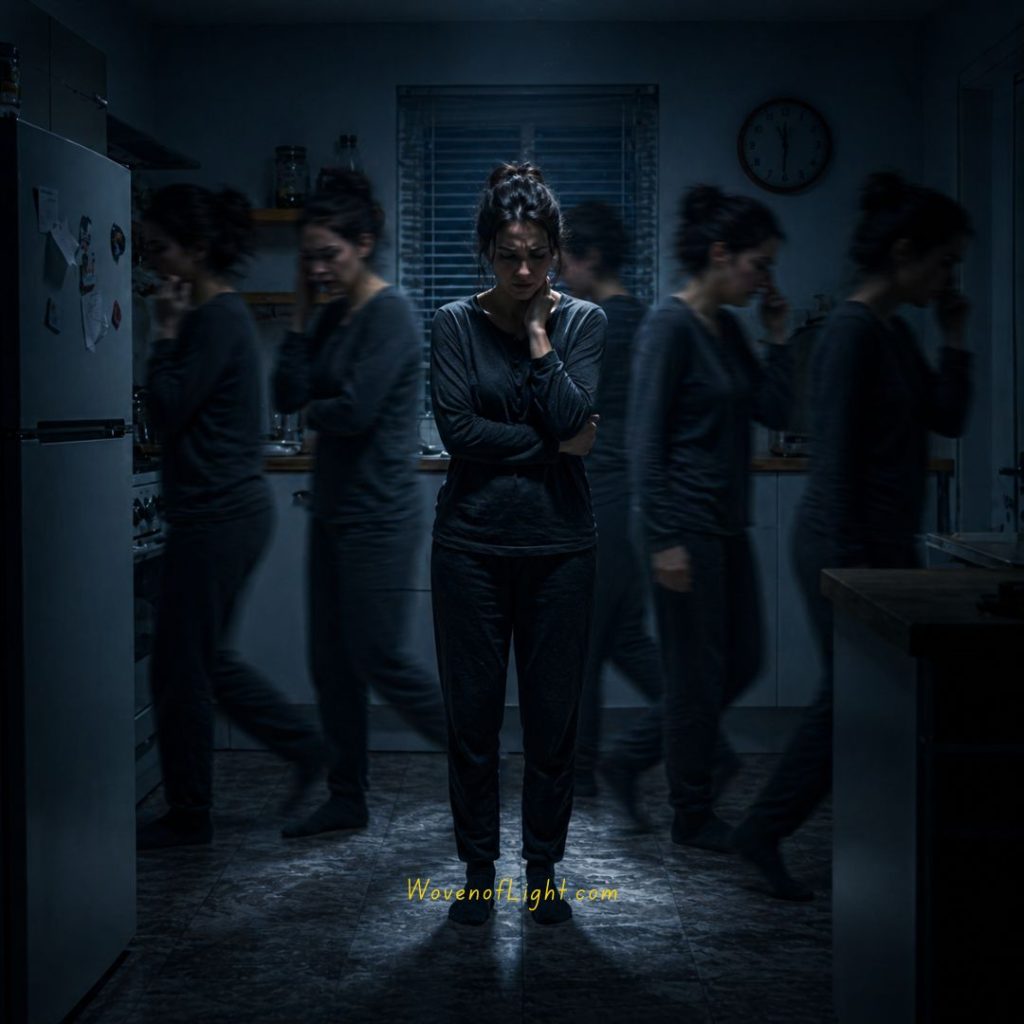
Trauma response feels old. Intuition feels current.
There’s a third voice most people lump in with the other two, and it deserves its own paragraph: trauma response.
Trauma response can sound like intuition because it’s body-based. It’s quick, it’s somatic, it bypasses thought. The difference is that it’s responding to something that’s already happened — a younger version of you, in an earlier room, with people who are no longer here. It’s a survival pattern doing its job a little too well.
The texture is different if you know what to feel for. Trauma response feels old. It feels like I have been here before. It comes with a contraction, a bracing, a tightening down. Intuition feels current. It’s responsive to what’s actually happening in front of you, not a memory wearing today’s clothes.
When you can’t tell the difference, the question to ask isn’t is this real? The question is whose voice is this, and from when?
Why exhaustion blurs the channel
Here’s the part most spiritual content skips. You can have a perfectly intact intuition and still not be able to hear it, because you’re depleted.
Intuition isn’t loud. It’s not a megaphone. It’s a steady, low signal that needs a quiet enough nervous system to land. When you’re running on three hours of sleep, too much caffeine, and a body that’s been holding too much for too long, the signal is still there — but it’s underneath the static.
This is why people who try to trust their gut while they’re burned out keep ending up in the wrong place. They’re not failing at intuition. They’re trying to read a quiet signal in a loud room.
The work, in those moments, isn’t to get better at decoding. It’s to get quiet enough to hear.
Sometimes that means a decision waits. Sometimes it means you sleep before you choose. Sometimes it means you stop asking the question for a day and let the answer come find you. None of that is procrastination. It’s letting the channel clear.
How to tell intuition from fear in the moment
If you’ve read this far, hoping for the part where I tell you what to do, here it is — but it’s not a checklist.
Stop asking what’s true. Start asking what’s loud.
Notice which voice is repeating. That’s fear. Notice which voice is bracing for an old wound. That’s trauma. Notice what’s left after both of them have had their say. That quieter, simpler thing — the one that doesn’t argue and doesn’t repeat — is closer to the truth.
If even that’s unclear, the most spiritual move available to you is rest. Not journaling. Not another meditation. Not another framework. Sleep. Food. Water. A walk. The body has to come back online before the knowing can.
I know this is the part that doesn’t sound mystical. But your nervous system is the antenna. If the antenna is fried, it doesn’t matter how strong the signal is.
Your intuition is allowed to be wrong sometimes
Here’s the part almost no one in spiritual content will tell you.
Intuition isn’t infallible. It’s a sense, and like any sense, it can be conditioned, distorted, or misinformed. A person raised in chaos will sometimes mistake chaos for home. A person who’s been betrayed will sometimes mistake suspicion for wisdom. Your knowing is shaped by what you’ve lived through, and some of that shaping needs to be unlearned, not trusted.
The goal isn’t to find a voice inside you that’s always right. It’s to develop a relationship with yourself, honest enough to know which voice is which — and to keep updating that relationship as you grow.
A wise person isn’t someone who never gets it wrong. It’s someone who knows themselves well enough to tell the difference between the parts of them speaking from now and the parts speaking from before.
What changes when you stop trying to tell
Something shifts when you stop demanding an instant answer.
You stop forcing yourself to pick between fear and intuition like it’s a multiple-choice quiz. You start to notice that most real decisions don’t come down to a single clear signal. They come down to who you want to be next — and your intuition tends to point in that direction even when fear is loud.
You also stop punishing yourself for not knowing. The not-knowing is part of it. Most of the people you admire didn’t make their best decisions because they had perfect clarity. They made them because they got tired of fear running the show, so they moved anyway.
That’s not a failure of intuition. That’s the slow, real, human work of becoming someone who can hear themselves.
If this landed somewhere honest in you, stay a while. There’s more here. A simple way to find balance in the body.
For the body-based side of this, particularly how trauma response and intuition can sound alike. The Body Keeps the Score: Brain, Mind, and Body in the Healing of Trauma by Bessel van der Kolk, M.D., is a useful read on the distinction between body wisdom and body memory.

If you needed this today, the conversation keeps going in two places.
— For the day-to-day, the real-life version of all of this: follow me on Facebook
— For the deeper work, the writing, and what’s coming next: Woven of Light on Facebook
FAQ
“Your intuition is the quiet voice that speaks once.”
— Christina